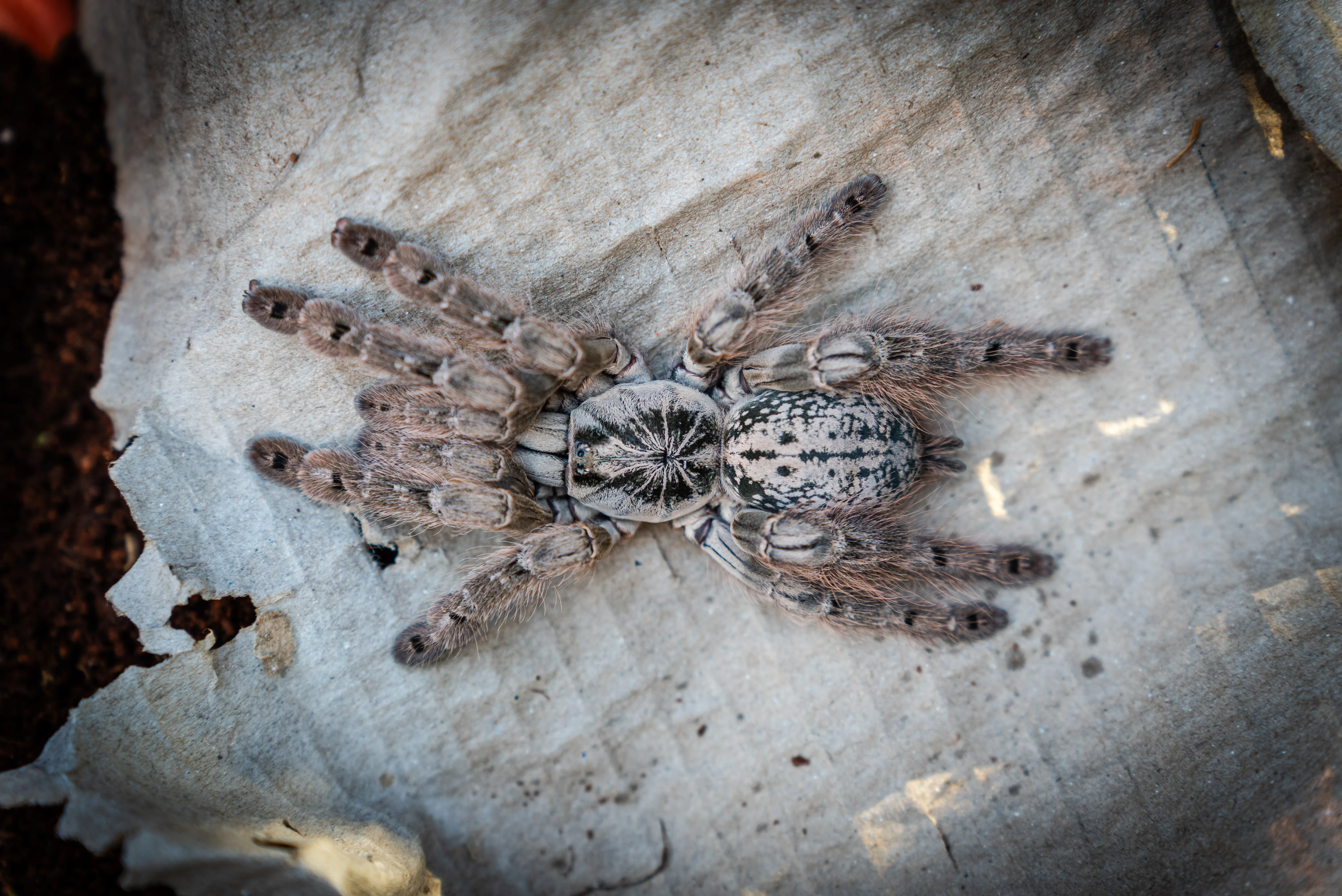
What do you think of my photo of my H. maculata?
The Togo Starburst Baboon (Heteroscodra maculata) is a species that commands respect through its ghostly beauty and lightning-fast reflexes. Having raised my specimen from a tiny sling of just a few millimeters to its current 10cm size, I have learned that keeping an “H. mac” is less about “owning” a pet and more about managing a force of nature.
A Masterpiece of Monochrome
Unlike the vibrant oranges or blues seen in other species, H. maculata relies on a sophisticated palette of chalky whites, ash greys, and deep blacks. The “starburst” name comes from the intricate, radiating pattern on its carapace, which is complemented by thick, mottled legs that look almost like sculpted marble.
One of their most distinct physical traits is the enlarged, somewhat flattened rear legs. These are not just for show; they provide the necessary power for the explosive bursts of speed this species is known for.
The “Teleportation” Factor
If there is one thing every keeper should know, it’s that this species defines the word “fast.” I’ve experienced firsthand the fright of seeing them move; in a single moment, it can dash in and out of its hide multiple times, moving so quickly the eye can barely track it. You haven’t truly experienced the speed of an Old World tarantula until you’ve seen an H. mac “teleport” back into its hide during a routine check.
Master of the Silk Fortress
Once settled and comfortable in its enclosure, the Togo Starburst becomes a tireless architect. My specimen is a heavy webber, constantly building its silk retreat higher and higher as time passes.
What makes their webbing fascinating is the functional design:
-
Tactical Exits: They create multiple exit holes throughout the silk structure for quick escapes.
-
Camouflage: They are remarkably industrious, collecting dirt and leaves to incorporate directly into the webbing. This creates a reinforced, opaque fortress that blends perfectly with the environment.
Behavior and Temperament
While many baboon spiders are terrestrial burrowers, the Togo Starburst is arboreal. In their natural habitat, they are found high in the trees, tucked into silk-lined crevices or hollows.
In a captive environment, they are legendary for their silk-work. They don’t just spin a web; they create elaborate “curtain” nests, weaving substrate and debris into their silk to create a fortress that is nearly invisible to the untrained eye. They are reclusive by nature, preferring to stay tucked away until the cover of darkness.
This is a reclusive, light-sensitive species. It truly “does not like to be disturbed” and will remain hidden if there is too much activity or light near the enclosure. It is a creature of the night, usually only emerging late at night when the room is completely dark.
When it comes to feeding, their “shy” nature disappears:
-
Aggressive Hunting: They are incredibly fast and aggressive when striking at prey.
-
The Hunger Gap: Interestingly, they can be unpredictable feeders. It isn’t uncommon for this species to go months without eating, which can be nerve-wracking for a new keeper, but is often just a natural part of their rhythm.
-
Incredible Speed: They can move faster than the human eye can easily track, often appearing to “teleport” from one side of the enclosure to the other.
-
Potent Venom: While not lethal to humans, an H. mac bite is medically significant and known to cause intense pain, muscle cramping, and localized swelling.
Habitat and Care Requirements
To successfully keep a Togo Starburst, the environment must mimic the humid, forested regions of West Africa:
-
Vertical Space: Since they are arboreal, height is more important than floor space.
-
Hydration: They require higher humidity than their arid-dwelling cousins. Regular misting and a clean water source are vital.
-
Cross-Ventilation: To prevent stagnant air and mold—which can be fatal to the species—good airflow through the enclosure is a must.
Final Thoughts
Raising an H. maculata from a tiny spiderling to a 10cm adult has been a rewarding challenge. They are not “display” pets in the traditional sense because they value their privacy so highly, but the moments you do catch them out under a dim red light make the months of looking at a “silk box” worth it.