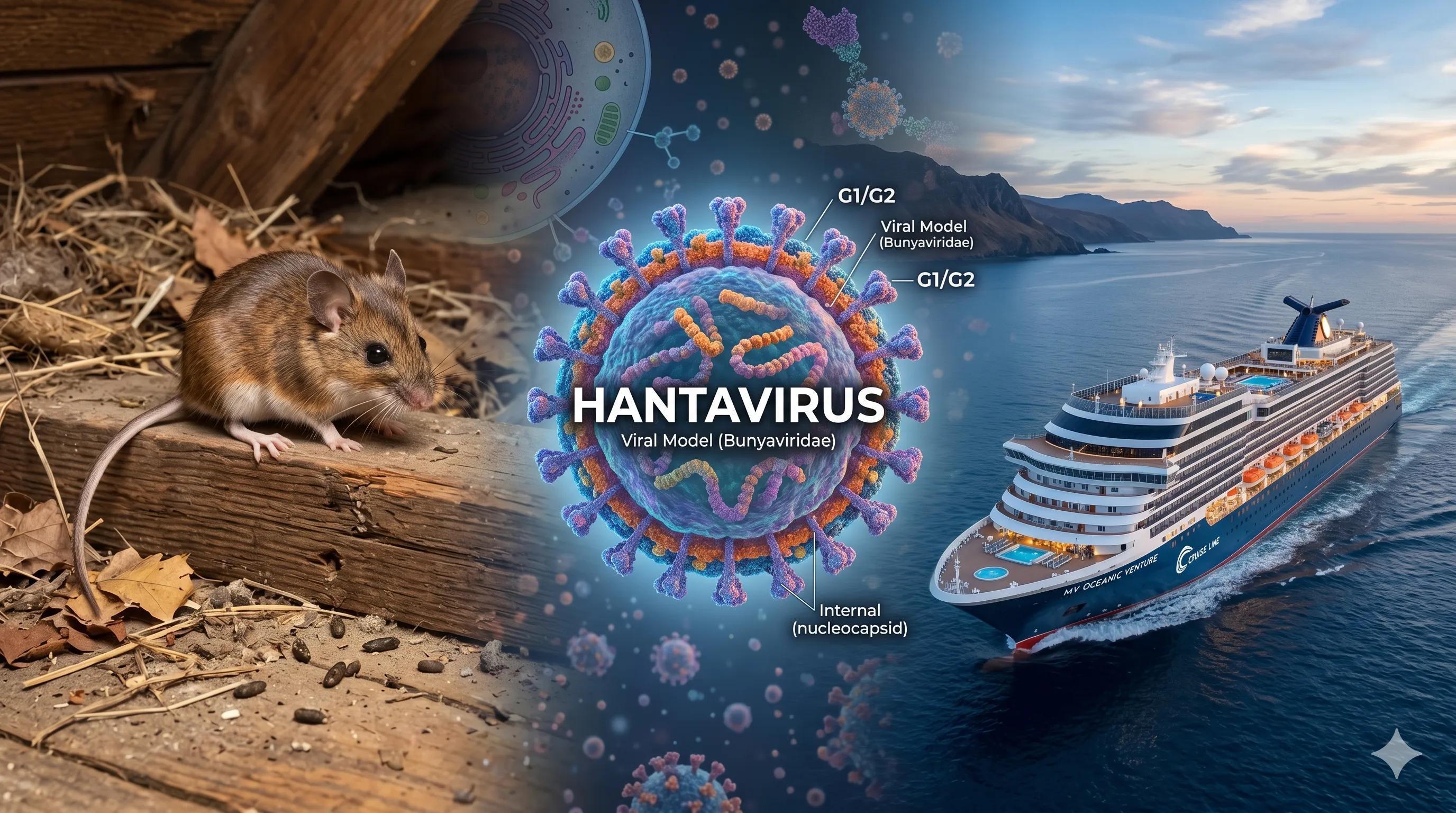
Hantaviruses are a family of viruses spread mainly by rodents. Unlike many other viral threats, they do not rely on insect vectors like ticks or mosquitoes; instead, they are tied directly to the ecology of their host’s environment.
The MV Hondius Incident (2026)
In April and May of 2026, a significant medical investigation was launched concerning an outbreak aboard the MV Hondius, a polar expedition cruise ship. The incident began when passengers presented with severe respiratory distress following travels through South American ports. Several fatalities were reported, including a Dutch national and his spouse, leading to an international health alert.
The mystery centered on how a typically terrestrial, rodent-borne virus could proliferate on a sea-bound vessel. While crew inspections initially found no signs of an infestation, subsequent sweeps by health authorities focused on the potential for rats to have entered the ship via cargo or gangways in Argentina. This specific case also brought attention to the Andes virus strain, which is unique for its ability to transmit between humans in close-contact environments—a factor suspected to have contributed to the spread among the ship’s passengers and crew.
Discovery and Identification
The virus is named after the Hantaan River in South Korea. While clinical descriptions of similar diseases date back centuries, the virus was first isolated in 1976 by Dr. Ho Wang Lee and his colleagues. This followed an outbreak during the Korean War (1950–1953), where thousands of United Nations troops fell ill with what was then called “Korean hemorrhagic fever.”
A second major milestone occurred in 1993 in the “Four Corners” region of the Southwestern United States. A sudden outbreak of severe respiratory failure among healthy young people led to the discovery of the Sin Nombre virus, the primary cause of Hantavirus Pulmonary Syndrome (HPS) in North America.
Geographic Problem Areas
Hantaviruses are broadly categorized into “Old World” and “New World” varieties based on where they are found and the symptoms they cause:
- The Americas (New World): Predominantly found in the United States, Canada, Argentina, Brazil, and Chile. These strains typically cause Hantavirus Pulmonary Syndrome (HPS).
- Europe and Asia (Old World): Common in China, the Koreas, Russia, and Northern/Central Europe (particularly Scandinavia and Germany). These strains generally cause Hemorrhagic Fever with Renal Syndrome (HFRS).
- Recent Trends: Climate change and urbanization have expanded the habitats of host rodents, leading to sporadic outbreaks in regions previously considered low-risk.
Transmission and Dangers
The primary danger of Hantavirus lies in its high mortality rate and the speed at which it progresses.
How it is Contracted
The virus is shed in the urine, saliva, and droppings of infected rodents (such as deer mice, cotton rats, or bank voles). Human infection typically occurs through:
- Aerosolization: This is the most common route. When dried droppings or nesting materials are disturbed, the virus becomes airborne and is inhaled.
- Direct Contact: Touching contaminated surfaces and then touching the mouth, nose, or eyes.
- Bites: Though rare, a bite from an infected rodent can transmit the virus.
Contagiousness
For almost all strains, Hantavirus is not contagious between humans. You cannot catch it by hugging or shaking hands with an infected person.
- The Exception: The Andes virus (found in South America) is the only Hantavirus documented to have limited person-to-person transmission in specific close-contact settings, as noted in cases involving direct exposure to respiratory droplets or bodily fluids.
Clinical Dangers
- HPS (Americas): Leads to severe fluid buildup in the lungs, causing respiratory failure. It has a mortality rate of approximately 38%.
- HFRS (Eurasia): Primarily attacks the kidneys, causing low blood pressure and internal bleeding. Mortality rates vary by strain, ranging from less than 1% to 15%.
Perspectives from Health Organizations
| Source | Key Statement Summary |
|---|---|
| CDC (Centers for Disease Control) | Emphasizes that rodent control in and around the home remains the primary strategy for prevention. |
| WHO (World Health Organization) | Highlights the “One Health” approach, noting that environmental changes and human encroachment into wild areas drive spillover events. |
| Mayo Clinic | Notes that early symptoms (fever, muscle aches) are often mistaken for the flu, which delays life-saving supportive care. |
Takeaway Conclusion
The Hantavirus is a high-consequence pathogen that serves as a reminder of the risks at the human-wildlife interface. Because there is no specific cure, vaccine, or highly effective antiviral treatment, prevention is the only reliable defense. If you are cleaning areas where rodents have been present, use wet cleaning methods (bleach solution) rather than dry sweeping to prevent the virus from becoming airborne. High-risk environments should be treated with extreme caution.
Also see the following related articles: